Yes — established sweepstakes casinos are legal in most US states and pay genuine prizes. The nuance that matters in 2026: a fast-growing list of states has banned the model, and “legit” ultimately depends on the individual operator. This page gives you the cited legal reality and a practical way to judge any brand.
Key takeaways
- The model is legal where it relies on a real no-purchase entry method and a play currency with no cash value.
- Since mid-2025, at least ten states have banned or effectively blocked it — and the number of fully-permissive states has fallen from 45+ toward ~30. (SweepsAdvantage 2026 map)
- You win prizes via a sweepstakes, not a cash wager — redeemable after KYC.
- Legitimacy is per-operator: judge the free path, verification, terms, and payout record.
Why the model is legal — and where that’s changing
A sweepstakes casino is a social-casino platform that runs a dual-currency (Gold Coins + Sweeps Coins) model under US promotional-sweepstakes law. That model runs on one rule: there is always a free way to obtain Sweeps Coins, and the play currency (Gold Coins) has no cash value. Because neither half of “wager cash to win cash” is present, the model has historically been permitted in many states where real-money online casinos are not.
That map is shifting fast. In 2025–26 a wave of statutes and enforcement actions targeted the dual-currency model specifically:
- California — AB-831. Signed October 11, 2025 and effective January 1, 2026, it bans operating or supporting online dual-currency sweepstakes games, with penalties up to $25,000 per violation. Notably, it extends liability to “media affiliates” — review and marketing sites. (CA bill text, ZwillGen analysis)
- New York — S5935A. Reportedly signed in December 2025, banning operating, conducting and promoting online sweepstakes games, building on the AG’s March 2025 cease-and-desist wave against 26 platforms. (US sweepstakes law guide, 2026)
- Montana, Connecticut, Nevada, New Jersey, Louisiana all restricted or blocked the model in 2025 by statute or enforcement, and Washington, Michigan, Idaho functionally prohibit it (Washington’s gambling law has no no-purchase exemption). (SweepsAdvantage, Track360 tracker)
- Indiana (HB 1052), Maine (LD 2007) and Tennessee (SB 2136) enacted dual-currency bans in 2026, effective July 1, July 14 and (on signing) May respectively. Oklahoma (SB 1589) takes effect November 1, 2026. Maine and Tennessee reach promoters and facilitators; Indiana’s civil ban targets operators.
Why this site hides offers in some states
Here’s something most comparison sites won’t tell you: because California’s AB-831 explicitly names “media affiliates”, a review site that shows a monetized offer to a resident of a banned state now carries real legal exposure — not just the operator. That’s why, in the banned states, we render information only and suppress affiliate links entirely. If you don’t see a “Claim” button, that’s by design for your state. Confirm your own state’s status on our state legality hub.
Can you win “real money”?
You win prizes, framed as a sweepstakes rather than gambling. Redeemable Sweeps Coins can be exchanged for cash or gift cards under each operator’s official rules, after you meet the minimum and pass identity verification. The mechanics are in how to redeem Sweeps Coins.
The difference from a real-money casino is structural: a real-money casino takes a cash wager for a cash return under a gambling licence; a sweepstakes casino gives free promotional entries (Sweeps Coins) that are redeemable for prizes, with a mandatory no-purchase path. That’s why the two are regulated differently — and why the sweepstakes model is now being banned in the states listed above.
How to tell a legit operator from a scam
Legitimacy is per-brand. Judge it on four signals — the same ones in our rating methodology:
A genuine free path
A real no-purchase method to get Sweeps Coins is the legal backbone of the model. If it’s missing or hidden, walk away — that single test screens out most bad actors.
Real identity verification (KYC)
Proper operators verify identity before paying prizes. KYC is a sign of compliance, not a red flag; its absence before large payouts is the red flag.
Clear, published terms
Bonus rules, playthrough multiples, redemption minimums, and payout timelines should be stated plainly and be easy to find. Vague or shifting terms are a warning sign.
A payout track record
A consistent public record of paid redemptions matters more than any marketing claim — which is why we aggregate real player reports rather than publish invented payout tests.
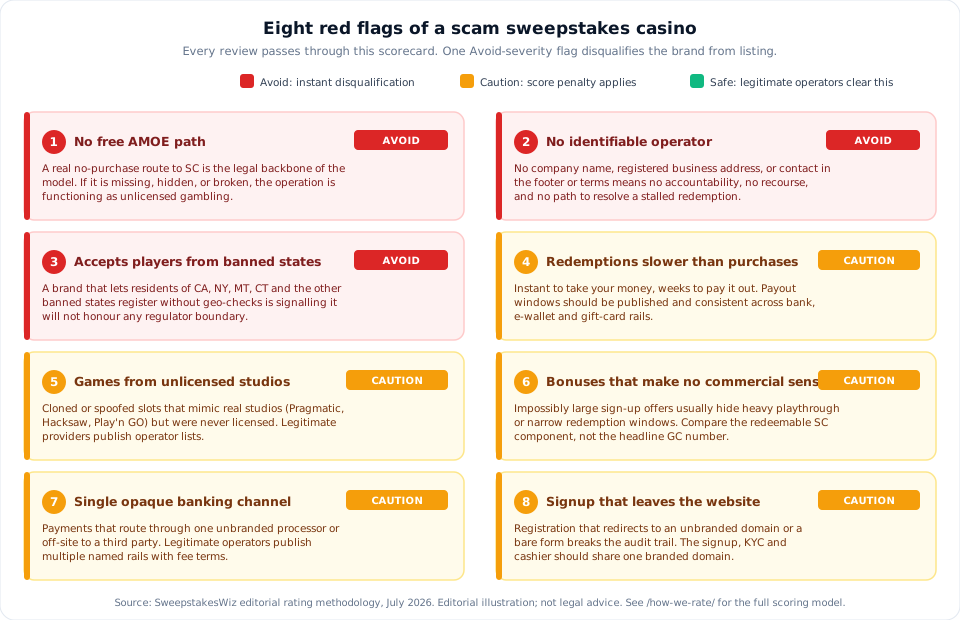
Red flags that should stop you
Walk away from any operator showing these — they’re the patterns behind most complaints:
- No no-purchase (AMOE) path, or one that’s buried or broken.
- Redemptions slower than purchases — instant to take your money, weeks to pay out.
- Games from studios that never licensed them (cloned or spoofed software).
- Bonuses that make no commercial sense — impossibly large offers hiding heavy playthrough.
- A single, opaque banking channel, or payments that route off-site.
- Signup that leaves the website to an unbranded page.
- Accepts players from banned states with no geo-checks.
- No identifiable operator — no company name, address, or contact behind the brand.
How to vet a sweepstakes casino yourself
You can screen most brands in a few minutes:
- Find the operator. Look for a named company, address, and contact in the footer or terms. Anonymous = avoid.
- Confirm the free path. Locate the mail-in / daily no-purchase method in the rules.
- Read the redemption terms. Note the minimum, the playthrough on bonus SC, the methods, and the stated timelines.
- Check security and games. SSL encryption, and games from studios that actually license to sweepstakes operators.
- Weigh the review record. Look at Trustpilot volume, recency, and the balance of themes — not a handful of cherry-picked quotes.
- Confirm your state. Check the state legality hub before you register.
If a sweepstakes casino won’t pay you
If a redemption stalls or is refused:
- Complete KYC fully and re-submit any rejected document (a bank-statement PDF; ID matching your registered address).
- Contact support in writing and keep the thread — dates and ticket numbers matter.
- Escalate formally — a factual Trustpilot review, plus a complaint to your state attorney general / consumer-protection office.
- If you purchased Gold Coins, a card chargeback for undelivered goods is a last resort.
Genuine operators resolve these; a pattern of unresolved non-payment across many players is exactly what keeps a brand off our rankings.
When a sweepstakes casino is not the right call
Skip it if any of these apply to you:
- You live in a banned state. Play may be blocked and prizes unredeemable — treat our pages there as information only.
- You’re chasing income. These are entertainment products; expected return is negative, like any casino-style game.
- You won’t complete KYC. No verification means no payout at a legitimate operator, full stop.
- A brand has no free path or no published terms. That’s the profile of the sites to avoid entirely.
Reviewed by Ilija Milosevic, iGaming analyst · Updated July 1, 2026.
How this was created: Editorial analysis, AI-assisted and human-edited. Legal claims are cross-checked against the cited primary statute (California AB-831) and independent law-firm and industry analyses; state-by-state status changes quickly, so treat this as a dated snapshot, not legal advice, and confirm your state before playing. No first-party testing is presented as fact.
Frequently asked questions
Are sweepstakes casinos legit in 2026?
Established sweepstakes casinos are legal in most US states and do pay real prizes, operating under promotional sweepstakes law (a free no-purchase entry method plus a play currency with no cash value). However, a growing number of states have banned the dual-currency model since 2025, so legality now depends heavily on your state and the specific operator.
Which states have banned sweepstakes casinos?
As of mid-2026, thirteen states have banned or effectively blocked the model: California (AB-831), New York (S5935A), New Jersey, Connecticut, Montana, Nevada, Louisiana, Michigan, Idaho, Washington, plus Indiana (HB 1052, effective July 1), Maine (LD 2007, effective July 14) and Tennessee (SB 2136). Oklahoma (SB 1589) takes effect November 1, 2026. The list is moving quickly — always confirm your state on our state legality hub.
Can you actually win real prizes?
Yes. Redeemable Sweeps Coins can be exchanged for cash or gift cards under each operator's official rules once you meet the minimum and complete identity verification (KYC). You win prizes through a promotional sweepstakes, not a direct cash wager.
What are the warning signs of a scam sweepstakes casino?
No genuine free (no-purchase) entry method; no identity verification before large payouts; vague, missing, or frequently-changing terms; redemptions slower than purchases; games from studios that never licensed them; a single opaque banking channel; signup that leaves the site; accepting players from banned states; and no identifiable operator. Legitimate operators are transparent about all of these.
What should I do if a sweepstakes casino won't pay me?
First complete identity verification (KYC) fully and re-submit any rejected documents. Contact support in writing and keep the thread. If it's still unresolved, escalate with a factual Trustpilot review and a complaint to your state attorney general or consumer-protection office; if you purchased Gold Coins, a card chargeback for undelivered goods is a last resort.